Singapore Website Project Timeline: What to Expect When Building Your Website in 2026
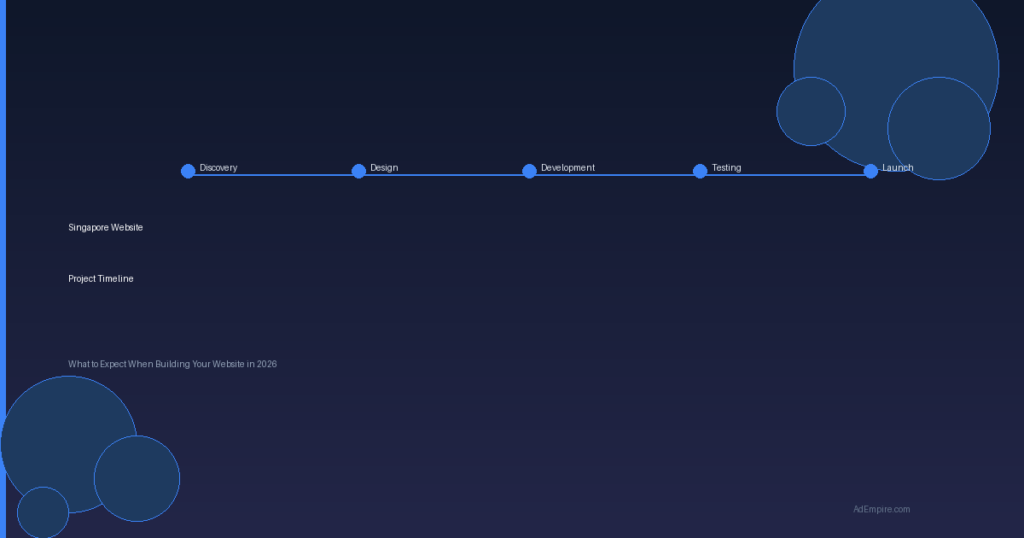
Every business owner who’s commissioned a website has asked the same question: how long will this take? The honest answer depends on the complexity of your project, the responsiveness of your team, and the quality standards of your chosen partner. But across hundreds of Singapore web design projects, certain patterns emerge.
This guide walks you through a realistic website project timeline Singapore — from the first discovery meeting to your site going live. Use it as a checklist, a planning tool, and a reality check that sets proper expectations before you sign a contract.
Phase 1: Discovery & Planning (Week 1–2)
Before any design or development work begins, your agency needs to understand your business inside and out. This phase is where the most expensive mistakes are prevented — or created. Many businesses treat discovery as a formality, but it’s actually the most critical phase of the entire project.
During discovery, expect to discuss your brand identity, target audience, primary business goals, and competitive landscape. Your web design company should also audit your current digital presence and identify gaps your new website will fill. If you’re launching a new product or entering a new market, this needs to be on the table from day one.
Key deliverables at this stage include a signed project brief, wireframes (basic page layout sketches showing content hierarchy), a content outline organized by site structure, and a technical specification document covering hosting requirements, integrations, and security needs. Some agencies also produce a sitemap document that maps out every page and its relationship to others.
What you need to provide: brand guidelines, high-resolution logos and assets, photography or access to a photographer, written copy for key pages (or a brief for a copywriter), access to existing analytics if applicable, and — most critically — timely feedback.
If your agency skips this phase or rushes through it, your website design will almost certainly miss the mark. Brief but critical detail: many scope disputes and project failures trace back to inadequate discovery.
Typical duration: 1–2 weeks, depending on how quickly your team provides feedback and assets.
Phase 2: UX Wireframing (Week 2–3)
Wireframing is the skeletal structure of your website — before aesthetics are applied. This step is often skipped or compressed by agencies working with templates, but for custom projects it’s where user experience is actually designed.
A wireframe shows where navigation lives, how content blocks are arranged, where calls-to-action appear, and how the page flows from top to bottom. It answers questions like: does the user know what to do next? Is the contact form visible at the right moment? Are product categories easy to browse?
In Singapore’s B2B sector especially, wireframes help align stakeholders before design makes the project feel “real” — and expensive to change. Use wireframe review sessions to get internal sign-off from everyone who has a say in the project. It’s far cheaper to move a box in a wireframe than to redesign a finished page.
Typical duration: 1 week for wireframes, concurrent with design.
Phase 3: Visual Design (Week 2–4)
Once the wireframes are approved, the visual design phase begins. Your designer will create high-fidelity mockups for your homepage, key landing pages, interior page templates, and any unique page designs your project requires — such as a custom checkout flow or an interactive calculator.
In Singapore’s competitive market, first impressions are made in under 3 seconds. Your website design needs to convey professionalism, build immediate trust, and guide visitors toward a conversion — whether that’s a phone call, form submission, inquiry, or online purchase. The design must also reflect your brand personality consistently across every page.
Expect 2–3 rounds of design revisions included in your contract. More than that often signals a problem in the planning phase. Come to review meetings with specific, actionable feedback — not vague reactions like “it feels off.” The more precise your feedback, the faster revisions close.
Typical duration: 2–3 weeks for design, often running concurrent with planning refinements.
Phase 4: Development (Week 4–8)
This is where your website comes to life. Front-end developers build what users see — the layout, animations, and interactive elements — while back-end developers handle databases, form processing, e-commerce functionality, and server configuration.
For a standard business website, development typically involves setting up a content management system (WordPress is the most common choice in Singapore for its flexibility and local support ecosystem), configuring essential plugins for SEO, security, and performance, building custom page templates, and integrating third-party tools like CRM systems, booking plugins, or email marketing platforms.
If you’re building an eCommerce website, development time increases substantially due to product catalog setup, payment gateway integration, shipping zone configuration, inventory management, and the additional testing required for checkout flows. A realistic eCommerce website timeline is 12–20 weeks for a fully-featured store.
Typical duration: 3–5 weeks for business websites, longer for custom or eCommerce builds.
Phase 5: Content Population (Week 5–8, concurrent)
Websites without content are expensive empty shells — and they’re more common than you’d think. Many businesses treat content as something to “fill in later,” then find themselves launching a beautiful site that says nothing compelling about the business.
Content population involves writing persuasive copy for each page, sourcing or commissioning photography and video, creating icons and supporting graphics, organizing everything into a logical site structure, and ensuring every page has a clear purpose and call-to-action.
Many businesses underestimate this phase badly. If your agency is providing professional content writing services as part of the project, factor in additional time for keyword research, editorial review, and SEO optimization. Content that’s written purely for humans while keeping search engines in mind performs far better than content written for neither.
Typical duration: 2–3 weeks, almost always running parallel to development — not after it.
Phase 6: Testing & Quality Assurance (Week 8–9)
Before launch, every link, form, button, and functionality must be tested rigorously across devices and browsers. A professional QA process checks:
- Responsive design rendering correctly on desktop, tablet, and mobile
- All form submissions trigger correct confirmations and admin notifications
- Page loading speed meets performance benchmarks
- Cross-browser compatibility across Chrome, Safari, Firefox, and Edge
- Accessibility compliance with WCAG 2.1 guidelines
- SEO on-page elements including titles, meta descriptions, heading hierarchy, and image alt text
- SSL certificates, HTTPS redirect, and security headers
- Functionality of all third-party integrations
Your internal team should conduct User Acceptance Testing on the staging environment. This means actually using the site the way a real customer would — not just clicking around randomly. Never approve a website for launch without personally testing the key user journeys: finding your contact information, submitting an inquiry, and completing whatever action your site is designed to drive.
Typical duration: 1–2 weeks, depending on site complexity.
Phase 7: Launch (Week 9–10)
Launch day feels like the finish line — but it’s really the starting line. Pre-launch technical tasks include DNS propagation and TTL adjustment planning, SSL certificate verification, setting up Google Analytics 4 with appropriate goals and conversions, configuring Google Search Console and submitting the XML sitemap, and ensuring all email addresses tied to your new domain are tested and working.
Your agency should also configure 301 redirects from any old URLs if you’re replacing an existing website, to preserve SEO equity. Failing to do this is one of the most common and costly launch mistakes in Singapore web design projects.
Post-launch, monitor your analytics closely. The first 30 days of real traffic will reveal how actual users interact with your site — and will almost certainly surface issues that didn’t appear during testing. Build a post-launch punch list and address critical items within the first two weeks.
Typical duration: 1 week for launch activities. Ongoing monitoring and iteration afterward.
Factors That Extend the Timeline
Several predictable issues routinely push Singapore web design project timelines beyond initial estimates. Knowing them in advance helps you plan better:
1. Scope creep — Adding features, pages, or functionality after development has begun is the single biggest cause of timeline overruns. Lock your scope document before a single line of code is written, and treat any changes as change orders that extend the timeline and budget.
2. Slow client feedback — Agencies can only move as fast as their clients. A 3-day turnaround on feedback seems minor in isolation, but across 8–10 weeks of development, accumulated delays can add 3–4 weeks to a project. Set internal deadlines on your side before the project starts.
3. Custom development requirements — Off-the-shelf themes and page builders significantly accelerate timelines. Custom-coded solutions offer greater flexibility and uniqueness but naturally take longer to build and test thoroughly.
4. Third-party dependencies — Waiting on brand guidelines from a regional head office, legal review of website copy, API credentials from a software vendor, or photography from an external studio can pause work entirely with no recourse.
5. Content delays — If your team is writing your own copy and it isn’t ready when development needs it, the timeline slides. Have content ready before development begins, or budget for a copywriter to work concurrently.
Average Website Project Timeline in Singapore
Based on projects completed for Singapore businesses across industries, here’s a realistic benchmark:
- Simple brochure site (5–8 pages, template-based): 6–8 weeks
- Standard business website (10–15 pages, custom design): 10–14 weeks
- Custom designed business website with advanced features: 12–18 weeks
- eCommerce website with full product catalog: 14–22 weeks
These estimates assume reasonable feedback turnaround (2–3 business days per revision round) and no major scope changes. In practice, most projects take 15–25% longer than quoted — not because agencies deliberately underestimate, but because real business projects involve real-world complications that no proposal can fully anticipate.
How to Keep Your Project on Schedule
- Appoint a single internal point of contact — too many stakeholders create conflicting feedback loops and bottleneck decision-making. One person should own the project on your side.
- Set clear response deadlines in the contract — agree on standard turnaround times for feedback before the project starts. Build in a “response by” culture on your end.
- Prepare all assets upfront — logos in high resolution, professional photography, written copy for key pages, brand guidelines, and access credentials should all be ready before development begins.
- Use shared project management tools — Trello, Asana, or Basecamp keep both sides accountable and provide full visibility into task status. If you can’t see what’s happening, you can’t manage it.
- Trust your agency’s process — experienced Singapore web design companies have refined their workflows across dozens of projects. If they’ve recommended a sequence or timeline, there’s usually a good reason.
What Comes After Launch
A launched website isn’t a finished product — it’s a live asset that requires ongoing attention to deliver its full value. In the months after launch, plan for:
- Regular content updates to keep the site fresh for both users and search engines
- Ongoing SEO work including content expansion, link building, and technical optimizations
- Performance monitoring and loading speed optimization
- Security patch management and automated backup verification
- Conversion rate optimization based on real user behaviour data
Many Singapore web design agencies offer website maintenance packages that bundle these activities. Budgeting for ongoing maintenance from day one prevents the post-launch neglect that causes many business websites to underperform within 12 months of launch.
Conclusion
Understanding the typical website project timeline Singapore helps you plan realistically, set proper expectations with stakeholders, and avoid the frustration that comes from misaligned timelines. A well-planned website project follows a logical, predictable sequence: discover, wireframe, design, develop, populate content, test, and launch. Each phase builds on the previous one — and rushing any phase inevitably compromises the next.
Work with an experienced web design company in Singapore that communicates clearly, manages scope rigorously, and provides transparent progress updates throughout. The best agencies aren’t necessarily the fastest or the cheapest — they’re the ones who deliver on time because they planned methodically from the start, and kept you informed every step of the way.
Ready to plan your website project with a team that respects your timeline? Talk to AdEmpire about your goals, budget, and ideal launch date.